
Autonomous AI Agents: The Difference Between Insight and Action
Most enterprise AI deployments stop at the insight layer. Data is processed, patterns are identified, reports are generated – and then a human decides what to do next. This is the chatbot model of AI: a sophisticated retrieval and summarisation tool that still requires human judgement to convert output into action.
Autonomous AI agents operate differently. They do not wait for a human to review a report and initiate a response. They plan, execute, self-correct, and produce real-world outcomes – approving loans, flagging compliance violations, updating records, triggering workflows – without a human in the decision loop at every step.
McKinsey's 2026 analysis of goals, decisions and implications for CEOs in the agentic age identifies the shift from generative to agentic AI as the defining enterprise technology transition of the current period – with competitive advantage accruing to organisations that operationalise agents in production workflows, not just proof-of-concept environments.
This article explains how Infomina AiMod's autonomous agent architecture closes the gap between insight and action – and what it means for the enterprise data problems that standard AI tools cannot solve.
What Makes an AI Agent Autonomous
The distinction between a generative AI tool and an autonomous AI agent is not a matter of degree – it is a structural difference in capability:
- A generative AI tool produces text or analysis based on a prompt. It does not act.
- An autonomous AI agent receives a goal, breaks it into tasks, selects the tools required to complete each task, executes them, monitors outcomes, and self-corrects when a step fails.
The autonomy comes from three architectural capabilities: planning (the ability to decompose a goal into an execution sequence), memory (the ability to maintain context across multiple steps without repeating work), and tool invocation (the ability to interact with external systems – databases, APIs, workflows – to produce real outcomes).
Without all three, an AI system is a text generator. With all three, it is an operational agent.
Why Verified Enterprise Data Is the Foundation of Reliable Agent Outputs
One of the primary objections to autonomous AI agents in regulated industries is accuracy. An agent that produces plausible but incorrect outputs – and then acts on them – is operationally dangerous. This is the hallucination problem that makes many enterprises reluctant to deploy agents in production.
AiMod addresses this by grounding every agent output in verified enterprise knowledge. This is why Infomina's approach is described as “Bring AI to the Data”: the agent operates on your actual data, inside your environment, producing outputs that can be traced back to specific source documents. This is Lineage and Logic, and it is what makes autonomous agents viable in regulated environments.
AiMod's Multi-Agent Architecture: Roles and Responsibilities
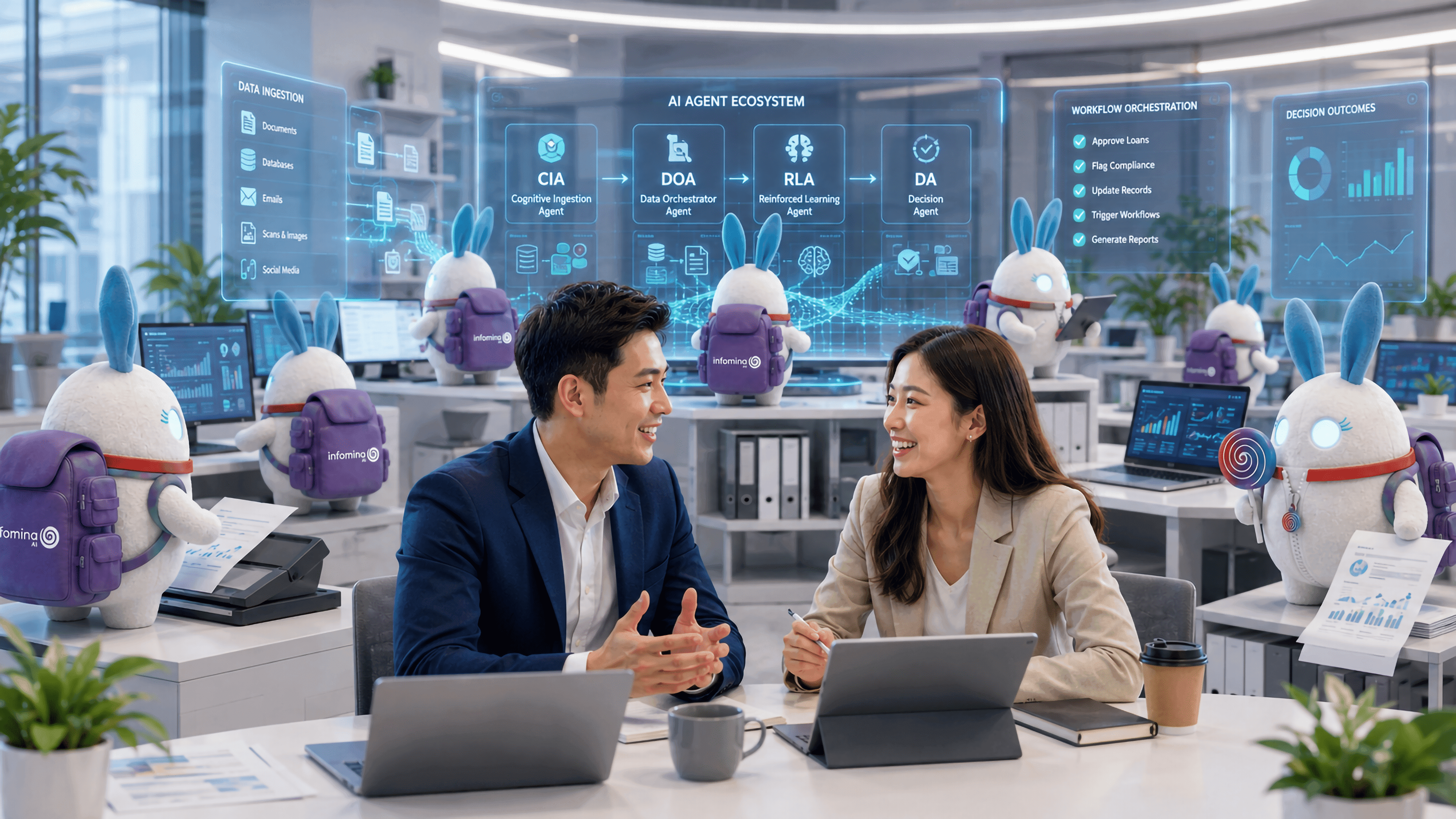
AiMod's autonomous agent ecosystem uses specialised agents with defined roles, rather than a single general-purpose agent attempting to handle every task. This specialisation prevents bottlenecks and allows the system to process complex workflows in parallel:
Cognitive Ingestion Agent (CIA) – The Data Layer
The CIA processes incoming data from any format – scanned documents, PDFs, structured database exports, social media feeds, images. It applies high-accuracy OCR and structured extraction to convert raw, unstructured inputs into clean, queryable data. This is the entry point for all enterprise data that needs to be acted upon.
Data Orchestrator Agent (DOA) – The Governance Layer
The DOA manages data movement and transformation within the enterprise's internal data infrastructure. It governs the unified data lakehouse, handles feature engineering, and ensures that data flowing into the decision layer is clean, current, and correctly structured. This is the agent that eliminates the data engineering bottleneck from model development cycles.
Reinforced Learning Agent (RLA) – The Intelligence Layer
The RLA builds and continuously updates predictive models from the enterprise's proprietary data. It evaluates risk signals, identifies patterns, and produces scores and assessments that the Decision Agent acts upon. Unlike a static model that degrades over time as market conditions change, the RLA recalibrates based on new outcome data – maintaining accuracy without manual retraining cycles.
Decision Agent (DA) – The Action Layer
The DA is where insight becomes action. It receives scored outputs from the RLA, applies business logic rules, and executes decisions – approving applications, flagging items for compliance review, generating reports, triggering downstream workflows. Every decision is grounded in verified enterprise data, meaning it is traceable to the specific information that shaped the output.
The Clean-Room Constraint: Sovereign Agents for Regulated Industries
AiMod operates on a Bring AI to the Data model. The agents, models, RAG infrastructure, and decision logic are all deployed within the enterprise's own secure environment. No data is transmitted to external cloud infrastructure at any stage. For regulated enterprises, sovereign AI deployment is the only viable path to production. AiMod is built for it.
The Enterprise Value of Autonomous Agents
The value of autonomous AI agents is not only in faster model development. It is in how they help enterprises move from insight to action across real operational workflows. In financial services, agents can support credit assessment, fraud detection, and loan processing. In public sector environments, they can help monitor content, process enforcement data, and produce audit-ready outputs. In compliance and governance use cases, they can support evidence tracking, decision traceability, and structured reporting.
See these outcomes across live deployments in Infomina's success stories: Consumer Electronics Recommerce, OCR & Enforcement Accuracy, Regulatory Spectrum Digitisation, Cybersecurity Assessments, and Transfer Pricing Automation.
See autonomous AI agents operating in your industry context. Schedule a demo with AiMod →